 Arts Access Aotearoa
Whakaari Aotearoa Drama New Zealand is a membership organisation supporting educators and teachers in drama education. A member of the Arts For All Network, Whakaari Aotearoa asked Katie Querin, Arts For All Activator, Arts Access Aotearoa to write an article for its August newsletter. The article is republished below.
At Arts Access Aotearoa, we believe access to the arts is a basic human right. It’s not a privilege, a favour or a nice-to-have. When we draw a circle around all the meaningful connections and inspirations the arts can offer us, we want everyone to find a place inside that circle.
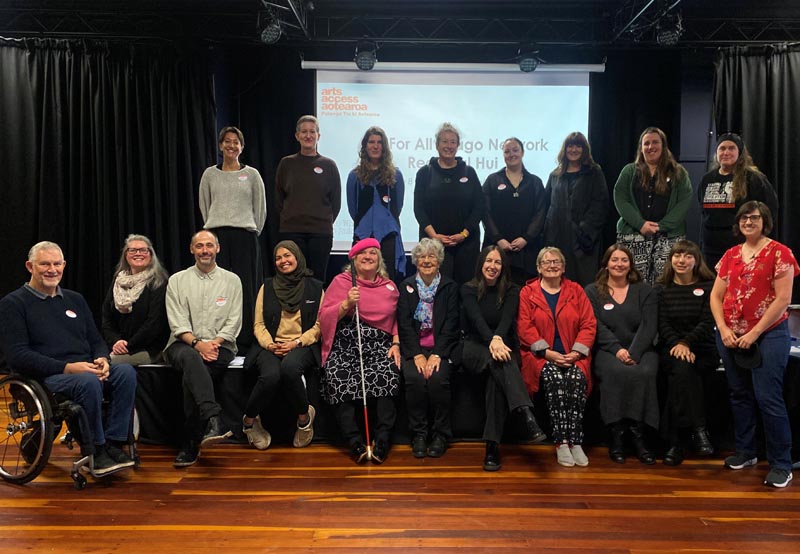
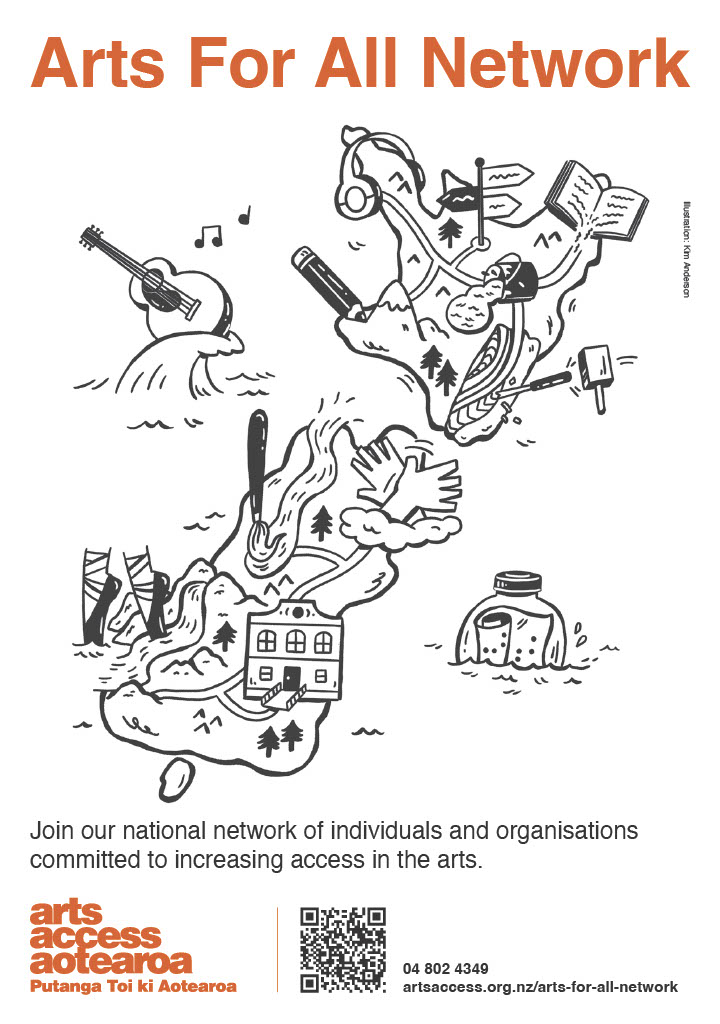 The Arts For All Network, facilitated by Arts Access Aotearoa, is all about supporting more people to enter the circle. The largest disabled-led arts accessibility network in the country, the Arts For All Network is made up of individuals and organisations from across Aotearoa – all working to increase access to the arts for Deaf and disabled people.
Network members come from arts organisations, local councils, creative spaces, the education sector and more; others are independent artists; and some just love the arts. What unites this diverse array of Deaf, disabled and non-disabled people is the singular drive to identify, reduce and remove barriers to the arts.
The framing of arts as a human right helps us apply arts accessibility in a practical way. It means that accessibility is our baseline rather than an addition to the top. It forms the wide, stable foundation at the base of the tower and we build upward from there.
We are seeing beautiful mahi happening when artists, organisations and arts lovers apply accessibility at the ground level. Creativity, artistry and even logistics such as ticketing and toilets can all be built from this stable foundation.
Contrast that with trying to build accessibility from the top down. That means dealing with structures that are already in place, possibly with barriers ready-built into systems that layer over the top of each other.
It’s like having to gut a tall tower, ripping out walls and shifting the layout rather than designing from the ground up with access in mind. This reno is much more costly, both financially and in terms of lost connection with potential visitors and tenants, than taking the time to build accessibility from the ground level.
 Arts educators and teachers are in a strong position to build accessibility into the foundation of their arts programmes and activities. They also play an important role in sharing knowledge that accessibility and creativity can go hand-in-hand. They can support thinking outside of the conventional, barrier-laden box, to push students to consider how all people can engage with their art. And they can work to ensure their curriculum is accessible to all their students.
There’s no one way to do art. Art allows us to think, feel and explore differently, and access is an exciting part of that exploration. If there’s a barrier, what if we change direction? Can we move up, down, sideways? Can we remove the barrier entirely? Once we can see the barriers, then we can find our way to access. Arts educators can support their students to discover that insight and offer alternative paths.
And the Arts For All Network can support arts educators in this work. The Network is open to anyone curious or passionate about arts accessibility. We welcome people of all backgrounds and experience levels with accessibility to engage with our programme of online and in-person activities, and to get in touch for one-on-one support and advice. There’s no cost to join the Network or to engage with us, and we welcome arts educators and teachers into the circle.
Read the latest from the Arts For All network
Discover our latest news and stories from the Arts For All Network, communities, events and advisor.
... loading ...