 Arts Access Aotearoa
Judith Jones’ commitment to audio description and inclusive arts practice was recognised at Te Putanga Toi Arts Access Awards 2020, where she received the Arts Access Accolade.
The Accolade recognises a person who has inspired the Arts Access Aotearoa team and helped advance its vision of a society where everyone in Aotearoa can access and participate in the arts. Unlike the other awards, its recipient is selected by Arts Access Aotearoa’s staff and board.
Judith had worked closely with Arts Access Aotearoa since beginning her audio description journey in 2014. Over the following six years, she shared her knowledge, contributed to resources and events, and continually encouraged deeper thinking about access and inclusion.
In recognising Judith, Arts Access Aotearoa said:
“Judith Jones is an outstanding advocate for access and inclusion in the arts. Arts Access Aotearoa values her commitment, generosity of spirit, deep knowledge and desire to learn more. She always goes the extra mile to support Arts Access Aotearoa’s mahi and push the boundaries of what is possible.”
Audio description as an art with a purpose
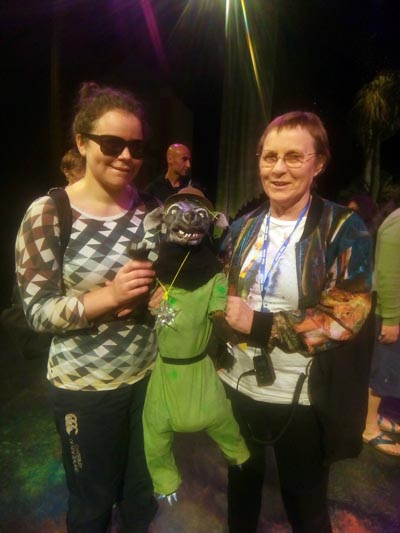
For Judith, audio description brings together her love of language and her commitment to making the arts more accessible.
“I love audio description and how it’s an art with a purpose,” she says.
“I’m a word person. I find words endlessly fascinating and I love using them in this context. I do a lot of research and enjoy building connections with our audiences and other describers, digging deep into how audio description works and understanding that it is an art in itself.
“The most important intention with audio description is always to write words that work, that support the listener or reader to make their own meaning.”
Judith’s involvement with Arts Access Aotearoa included writing and advising on audio description resources, speaking at events and panel discussions, and contributing to the Arts For All Wellington Network. She also represented Te Papa Tongarewa through her work there at the time of the award.
Learning from the audience
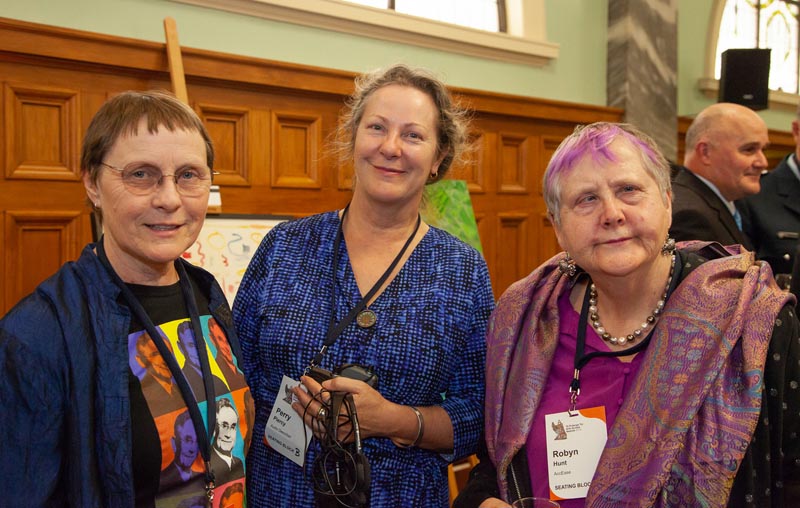
Judith began training as an audio describer in 2014 through a course facilitated by Arts Access Aotearoa. One of her earliest public tours taught her that the audience must always guide the work.
“On my first public audio description tour, I thought I was so well prepared,” she recalls. “I’ve never been good at numbers and had come up with ‘it’s like’ descriptions for the sizes of objects, and I was quite proud of that.
“For one object, I said, ‘It’s as big as a bath towel’. One of the audience asked, ‘How big is that in metres?’ and I checked the label to find out. I’ve included the actual measurement ever since.”
The experience helped Judith understand that audio description cannot be developed in isolation.
“It jolted me into really understanding that audio description doesn’t sit there by itself. It’s an art with a purpose.”
Working with blind and low vision communities
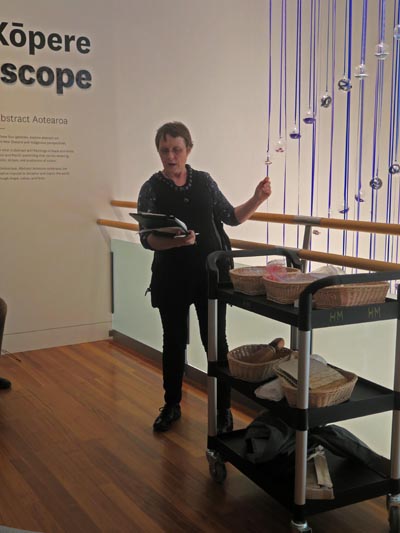
In 2015, Judith helped develop a pilot audio-described tour of selected works in Ngā Toi | Arts Te Papa. A reference group of blind and low vision people helped shape the experience from the beginning.
“We all met to talk about the gallery spaces, hear what our audience would like to experience and discuss how we could deliver this most effectively,” Judith says.
“We worked closely with the reference group, who were ready to challenge us, state their expectations and let us know what worked for them. I learned so much about how to be an advocate.”
Judith went on to support audio describer training and provide live and recorded description for arts events, exhibitions and performances.
As a founding member of Wellington Integrated Dance, she also delivered audio description for The Art of Observation at the New Zealand Fringe Festival 2020.
“People told me they experienced the audio description as an integral and rich part of the whole,” she says.
Making access part of the conversation
Judith’s advocacy is grounded in the belief that Deaf and disabled people must be involved in shaping accessible arts experiences, policies and services.
She recalls seeing a message written on a blackboard while attending a youth leadership camp:
“If you’re not part of the solution, you’re part of the problem.”
“It shifted something in my mind about who and how I might be as a person,” she says.
Through her generosity, curiosity and willingness to listen, Judith has helped strengthen understanding of audio description and encouraged arts organisations to treat accessibility as an essential part of their work.
Read the latest from the Arts For All network
Discover our latest news and stories from the Arts For All Network, communities, events and advisor.
... loading ...