 Arts Access Aotearoa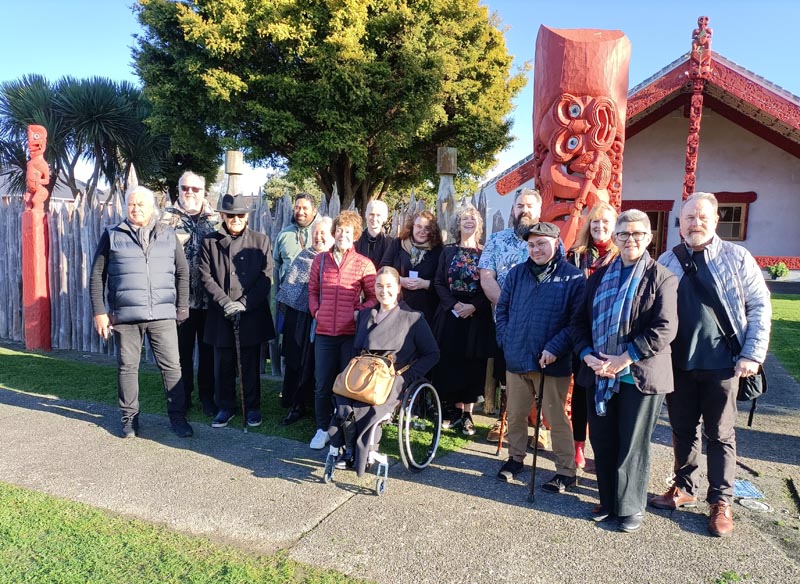
Conor Twyford, second from the right, with Arts Access Aotearoa whānau outside Arohanui ki te Tangata | Te Ra o Te Raukura at Waiwhetū in Lower Hutt in May 2023 before our visit to deepen our knowledge of Te Ao Maōri. At left are Te Aturangi Nepia-Clamp (a trustee at the time and now Kaumātua) and Kaumātua the late Bill Kaua.
My whakaaro for Waitangi Day, for every day really, is about gratefulness, and about whanaungatanga.
I am grateful for all of the generosity that mana whenua and tangata whenua have shown to me as Pākehā over my lifetime, in all the many ways this has manifested.
For the gift of being taught the reo in many spaces. For being gifted concepts and metaphors that allow me to connect to the whenua in a way that te reo Pākehā, except perhaps through poetry, really struggles to do.
For the many moments in which patience and aroha have been shown to me.
For being challenged to be a better version of me in many spaces and places, and yet at the same time being accepted for who I am as queer, quirky and working class. There are innumerable ways.
Bonded in love and obligation
It’s only in recent years that I really began to understand the deeper meaning of whakawhanaungatanga. That whakawhanaungatanga is at the heart of everything. That if we build a strong foundation of truly knowing and understanding each other – where we have come from, who we are, who our ancestors are, what makes us tick, what grieves us and ails us, what informs our thinking and acting, when we make ourselves vulnerable to each other in those moments – then we can build the movements and communities that we need.
Without whakawhanaungatanga, there is nothing. With it, we can build the revolution we all so desperately need.
I came to understand that through whakawhanaungatanga we not only connect to each other but we are also, in fact, inseparable. We cannot escape each other. We become bonded in love and also in obligation.
All we have is our connection to each other
That, for me, is whakawhanaungatanga. It’s not a difficult concept to understand and I think many people in our communities understand it implicitly.
However, it’s a concept this government doesn’t seem to understand – that ultimately, all we have is our connection to each other.
I joined the Arts Access Aotearoa team in 2022 as its Policy Principal Kaiārahi Kaupapa. Over that time, we’ve worked together, developing numerous policies and strengthening our knowledge of te ao Māori.
Under the guidance of our Kaumātua, the late Bill Kaua, and then Kaumātua Te Aturangi Nepia-Clamp, Arts Access Aotearoa became a Treaty partner organisation. This means our work is grounded in te Tiriti o Waitangi and our mahi is the stronger for that commitment. Read our te Tiriti Statement
Indeed, one of Arts Access Aotearoa’s values is Whanaungatanga (valuing relations and partnerships), along with Mōhiotanga (understanding and awareness), Rangatiratanga (respecting the mana of others) and Kotahitanga (working in harmony towards shared vision).
I feel an intense physical connection. And the aroha and obligation it brings with it is why all of us Tangata Tiriti must fight, with every ounce of our being, to uphold te reo, to uphold te Tiriti, to defend this whenua alongside our Māori whānau.
Insults inflicted on Māori colleagues and friends
In my life, I walk in many worlds and I have seen so many different kinds of racism inflicted on tangata Māori. Not least in the climate movement. I have viscerally felt the insults, to the extent that a Pākehā can feel those insults, inflicted on Māori colleagues and friends.
There’s the anger that comes from the head when you see these things happening. But when you feel it in your body and in your heart – because we ARE inseparable from each other – then you have to act on it. Not just because it’s the right thing to do but because it’s the only thing to do. This is all of our fight, not just for Māori.
And let me be clear. It’s not just this government, which has brought on a fight they don’t know how to handle. It’s every flavour of government and institution that has been imposed in and on this whenua.
Racism and colonialism is ingrained in the air we breathe, in every institution, every workplace, every conversation.
Our task, our heartfelt, physical obligation as Tangata Tiriti, is to do whatever we can, whenever we can, to stand alongside our Māori whānau. As workers, as parents, as friends, whatever it takes. Find your place, find your voice in the struggle.
Ngā mihi aroha ki a koutou.